


Updated
Older Michigan foundations, the block basements of the postwar decades and the brick and stone walls under prewar homes, crack differently from newer poured walls. They also come with history: old patches, painted-over stains and repairs nobody wrote down. Here’s how we approach them.
Start with what’s already been done
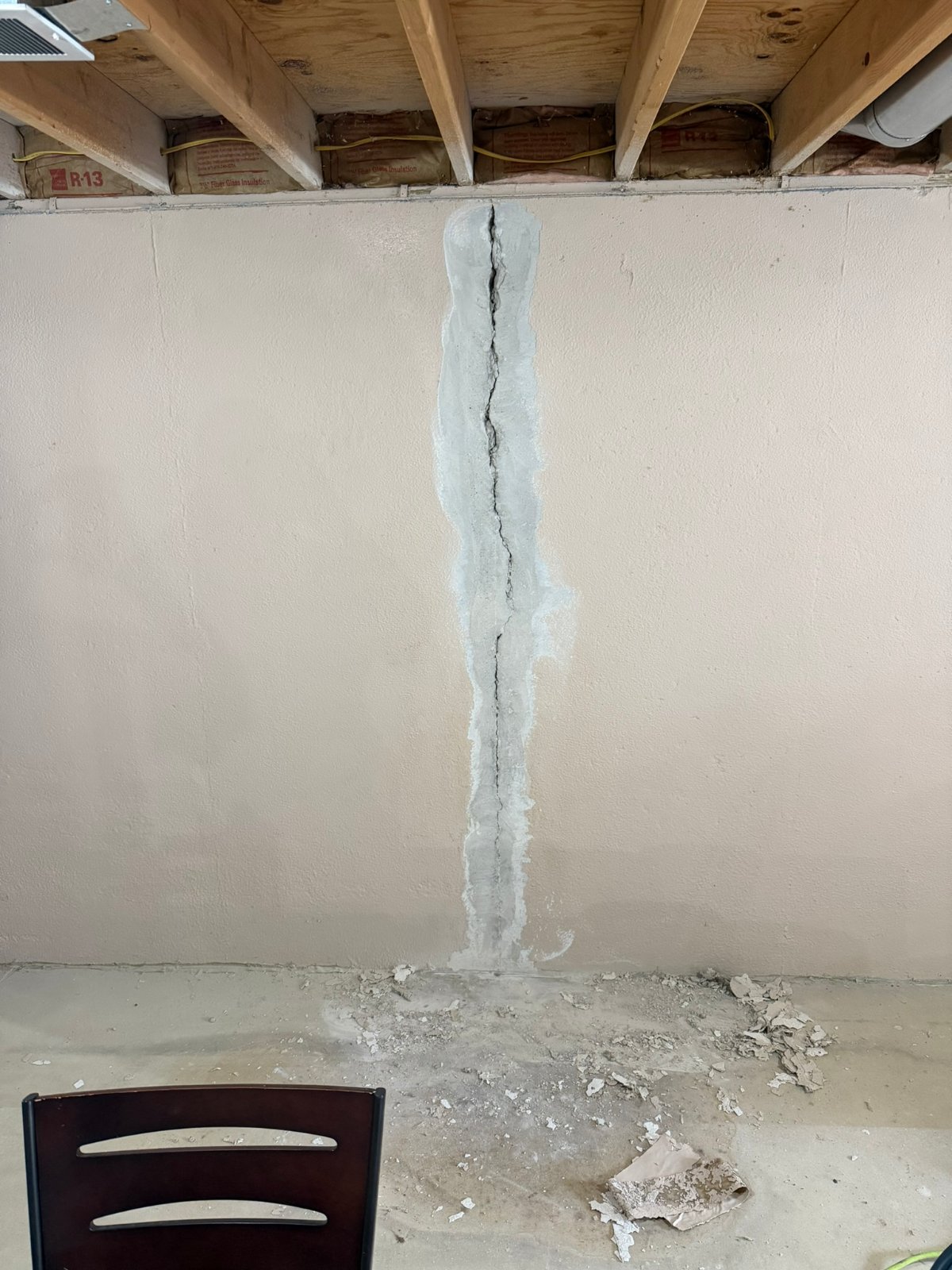
Older basements often have layers of previous repairs: hydraulic cement in the cracks, a coat of waterproof paint, a patch where a pipe used to come through. Some of it helped. Some of it is hiding the real path the water takes. We look under and around old repairs before deciding what to do.
Block walls
Postwar block basements, common in south Macomb, south Oakland and Wayne County, crack along the mortar joints. A stair-step crack can be settlement. A long horizontal crack partway up the wall usually means the wall is being pushed in by saturated, freezing clay.
- Leaking joints along the bottom: weep holes and an interior drain, because the block itself is full of water.
- Bowing walls: carbon fiber reinforcement, approximately $1,500 to $2,500, for walls that have only started to move, or steel I-beam wall braces, approximately $1,500 to $4,000 per brace, fastened to the joists above and the footing below the slab. Contact us for accurate pricing. We have to inspect the job before we can give you a price.
Brick and fieldstone
Prewar homes in the Grosse Pointes and older parts of Wayne and south Oakland County often sit on brick or stone. Mortar wears out, and cracks follow the joints. These walls need to breathe, so a thick coating on the inside usually makes things worse by trapping moisture in the masonry. Drainage and keeping water away from the outside work better.
Older poured walls
Poured walls from the 1960s on leak at cracks and rusted tie-rod holes. Those get injected through the full thickness of the wall.
Before you buy an older house
- Look for fresh paint on the lower walls and new carpet in an otherwise old basement.
- Check for horizontal cracks and walls that aren’t straight.
- Ask the seller what’s been repaired and when.
We can look at a basement before you buy and tell you what we see.
We’re Mansour’s Innovations, a waterproofing, excavation and plumbing contractor in Shelby Township, in business since 2014 and working across Macomb and Oakland counties. Call (586) 345-7292 for a free estimate. We answer calls from 8 a.m. to 8 p.m., seven days a week.
Frequently Asked Questions
1. How do you repair cracks in an older Michigan foundation?
It depends on the material. Poured-concrete cracks are sealed with epoxy injection. Block walls need weep holes and often an interior drain system because water sits in the cores. Old brick or stone foundations usually need drainage management rather than injection, since they cannot be injected the same way.
2. Can old stone or brick foundations be waterproofed?
Yes, but differently. Because you cannot inject them like poured concrete, water is typically managed with an interior drain-tile system and sump, and sometimes exterior work. We assess the wall and recommend what actually holds up on an older foundation.
3. Is epoxy injection right for an old foundation?
Epoxy injection works great on poured-concrete cracks. On block, brick or stone it is usually not the right tool on its own, so the fix leans on drainage and, where possible, exterior work. We use epoxy only, where injection is appropriate.
Leaking tie-rod holes in a poured wall? See rod hole repair (approximately $150 each, less when there are several). Local pages: basement crack repair in Sterling Heights, Rochester Hills, Troy, Clinton Township, Shelby Township, Macomb County and Oakland County.